SEEING BENEATH THE SURFACE
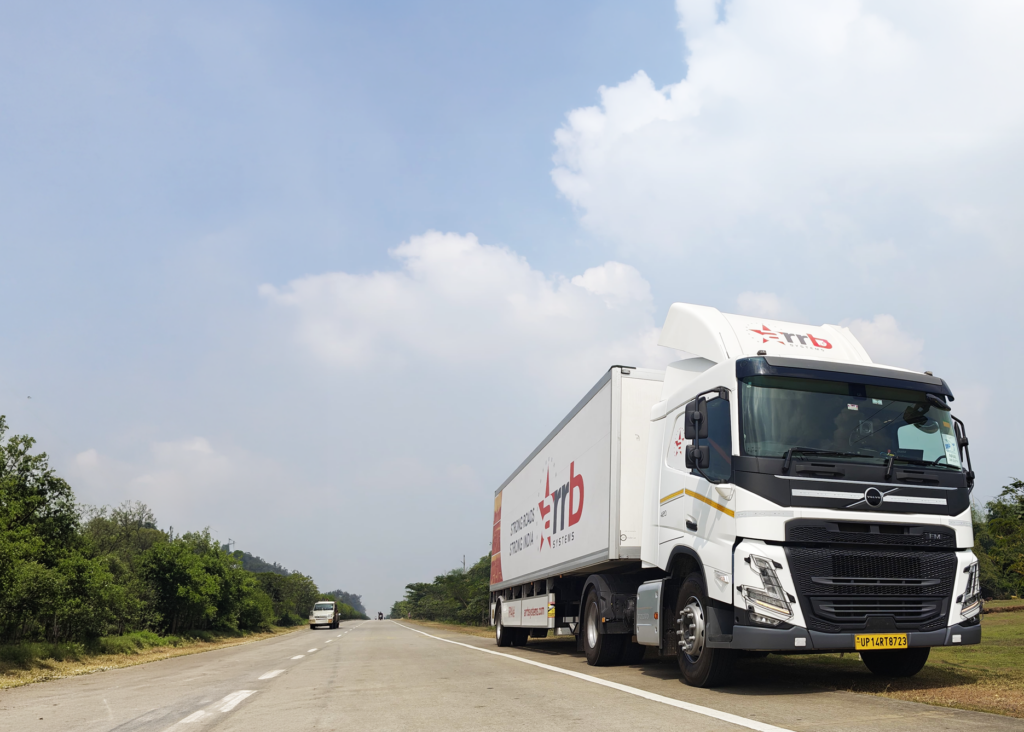
ARRB Systems has demonstrated traffic speed pavement assessment on an Indian highway.
India’s road network spans more than 6.6 million kilometres, making it the second largest in the world. And while the most critical arteries – the national highways represent around only 2% of the network they carry about 40% of all traffic.
While managing these heavily loaded corridors requires accurate, timely information about pavement condition, obtaining that information has traditionally involved compromise.
Network surveys provide extensive coverage of surface condition, and falling weight deflectometer (FWD) testing delivers valuable structural insights. The challenge is that neither method can efficiently provide continuous structural condition data across large networks without affecting traffic operations.
A recent pavement assessment on National Highway 44 (NH 44), between Delhi and Agra, explored how traffic speed deflectometer (TSD) technology, which delivers continuous structural and functional pavement measurements at normal traffic speeds, can bridge the gap.
THE MISSING PIECE
For many road agencies, pavement condition monitoring is built around two complementary approaches.
One is the network survey vehicle that collects functional indicators such as roughness, rutting and cracking at traffic speed, essential measurements for understanding ride quality and visible deterioration.
At the other end of the spectrum, FWD testing provides structural information by applying a controlled load to the pavement and measuring resulting deflections.
While FWD is highly regarded as a structural assessment tool, these surveys are conducted at discrete points that require traffic control measures, and they can only sample a small proportion of the network within practical timeframes.
The limitations are obvious. Pavements do not always deteriorate from the surface down; structural weakness can develop long before visible distress appears, leaving agencies to make rehabilitation decisions based on incomplete information.
This is where the ARRB Systems’ Intelligent Pavement Assessment Vehicle (iPAVe) comes in. The iPAVe combines TSD technology with multiple sensing systems, allowing structural, functional and visual pavement data to be collected simultaneously at speeds of up to 80km/h.
The system applies a known axle load while an array of Doppler laser sensors measures pavement surface velocity at multiple locations surrounding the loaded wheel. Through data processing and integration, these measurements are converted into a continuous pavement deflection profile to gain a detailed picture of structural response across the entire survey route.
The result is something that has historically been difficult to achieve – the continuous collection of structural condition information under live traffic conditions.
TESTING THE TECHNOLOGY IN INDIA
India provided a valuable real-world test for the technology, with ARRB Systems deploying the iPAVe on NH 44 to assess its ability to deliver consistent structural measurements at traffic speed and compare the results with conventional FWD testing.
NH 44 is India’s longest national highway, extending more than 4100km from Srinagar in the north to Kanyakumari in the south. The study focused on a 15km six-lane section located on the Delhi–Agra corridor, one of the country’s most important freight and passenger transport routes.
The survey programme consisted of two key components.
The first involved repeatability testing over an initial 5km segment. Multiple runs were conducted in both directions to assess the consistency of the measurements.
The second component involved structural validation, with iPAVe measurements collected across all traffic lanes and compared directly with conventional FWD testing. FWD measurements were undertaken at 50m intervals using a target load of 50kN.
Importantly, all surveys were conducted under normal traffic conditions. Vehicle speed variations, lateral wander and the practical realities of operating on a busy national highway created a challenging environment that closely reflected real-world deployment conditions.
With the field data collected, the evaluation first examined whether iPAVe could produce consistent results across repeated survey runs.
Repeatability is critical for any networklevel structural assessment technology. If successive measurements cannot reliably reproduce the same result, confidence in the data quickly erodes.
The NH 44 trial demonstrated a high degree of repeatability in pavement deflection measurements. The key structural indicator, D0 deflection at the load centre, showed remarkably consistent profiles between survey runs.
Analysis produced an overall coefficient of determination (R²) of 0.96, indicating very strong agreement between repeat measurements despite changes in vehicle speed and positioning that naturally occur in live traffic environments.
For pavement engineers, this result is significant in that it demonstrates the system is responding to actual changes in pavement structure rather than measurement noise. In practical terms, it means road agencies can confidently identify locations of genuine structural weakness and monitor their progression over time.
The next step was to compare the traffic-speed measurements with an established structural assessment method.
While repeatability is important, validation against established methods remains essential. The study therefore compared iPAVe outputs against FWD measurements across all surveyed lanes.
Overall, the datasets displayed strong agreement in overall magnitude and deflection trends (Figure 1).
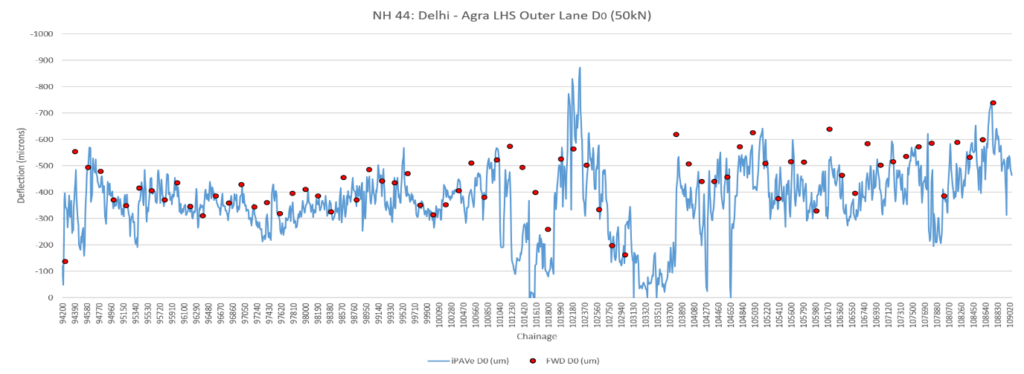
Perhaps more interestingly, the iPAVe revealed localised variations in structural response that were not visible in the FWD data. This is a direct consequence of measurement density.
A typical FWD survey collects information every 50m. A TSD system, however, effectively measures continuously, capturing subtle changes that can occur between traditional test points.
Some reduction in correlation was observed at sensor locations furthest from the load application point. This was expected.
Deflections at these positions are often extremely small, approaching the practical measurement limits of conventional FWD equipment.
Differences in dynamic versus static loading behaviour, particularly in asphalt pavements under elevated temperatures, also contribute to minor variations between the two methods.
Despite these factors, the overall correlation was strong and provided confidence in the structural measurements obtained at traffic speed.
MORE THAN DEFLECTION DATA
The most powerful aspect of the iPAVe is its ability to collect multiple datasets simultaneously.
The NH 44 survey demonstrated this capability through the integration of ground penetrating radar (GPR) with structural response measurements.
While the TSD component measured pavement deflection, the GPR system assessed subsurface layer thicknesses by identifying dielectric contrasts between pavement materials. When these datasets are combined, engineers assess not only how the pavement responded to loading but also why it behaved that way.
The information was further processed through the ARRB Systems’ Hawkeye Insight platform, where automated segmentation tools identified 31 uniform structural sections across the survey area (Figure 2 and Figure 3).
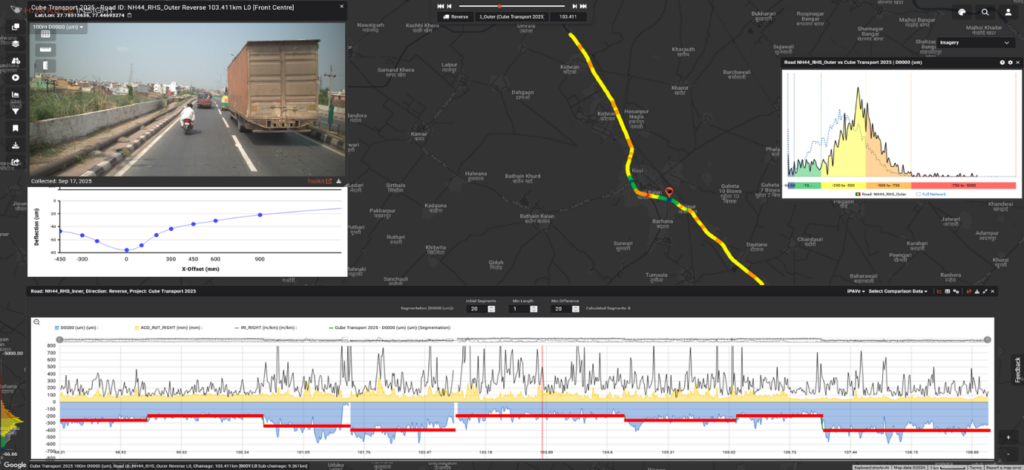
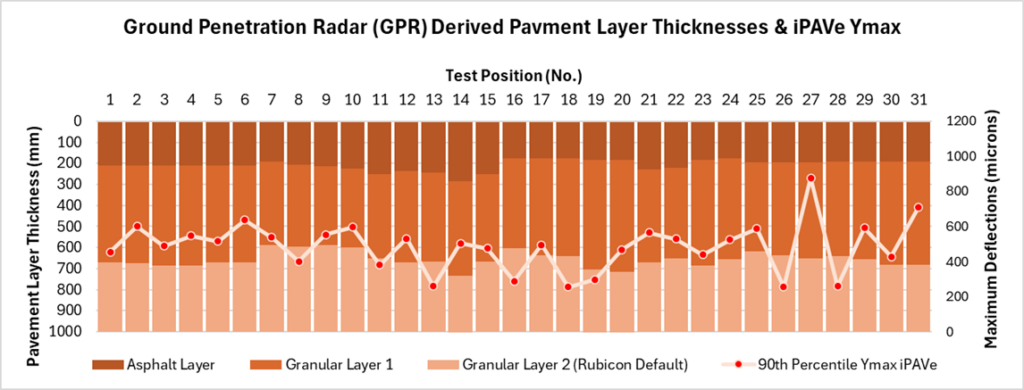
Each section represented pavement lengths exhibiting similar structural characteristics, providing a practical framework for maintenance planning and future investigations.
Combining continuous deflection data with pavement layer thickness information enables back-calculation of layer stiffnesses and estimation of remaining service life.
This creates a far richer understanding of pavement performance than reliance on functional indicators alone. Ater all, roughness, rutting and cracking describe symptoms, and structural assessment helps identify the underlying cause.
The NH 44 pilot showed that traffic-speed structural assessment can be successfully deployed on one of the world’s busiest highways. Th e results showed excellent repeatability in deflection and roughness measurements, strong correlation with conventional FWD testing, and advantages in spatial coverage and operational efficiency.
Most importantly, however, the study highlighted a shift in how pavement condition can be understood at the network level.
Rather than relying solely on visible surface distress or isolated structural sampling points, agencies now have the opportunity to view pavement performance continuously and comprehensively.
As transport authorities around the world seek to maximise the value of increasingly constrained maintenance budgets, technologies that reveal developing structural issues before they become visible failures will play an increasingly important role.
The clear message is that the future of pavement management lies not just in measuring what can be seen on the surface. Rather, it lies in understanding what is happening beneath it.
The NH 44 results suggest that traffic-speed structural assessment could play an increasingly important role in India’s pavement evaluation framework, providing road agencies with a way to collect detailed structural information across a network while maintaining normal traffic operations.
Originally published in Global Outlook: Road Surface Technology 2026.